
By Michelle Gold, in Fullfillment of MDIV studies, Feinberg Center, NYC
What if Adonai had created a fountain of life where all who came to the waters could be forgiven? Imagine Adonai created this place where we could throw a penny in for every ounce of iniquity with sincere confession? What if this place had its own special manual sent from heaven with a promise that all sin would be atoned for at this fountain? Wouldn’t it be glorious to be reconciled with G-d in this way?
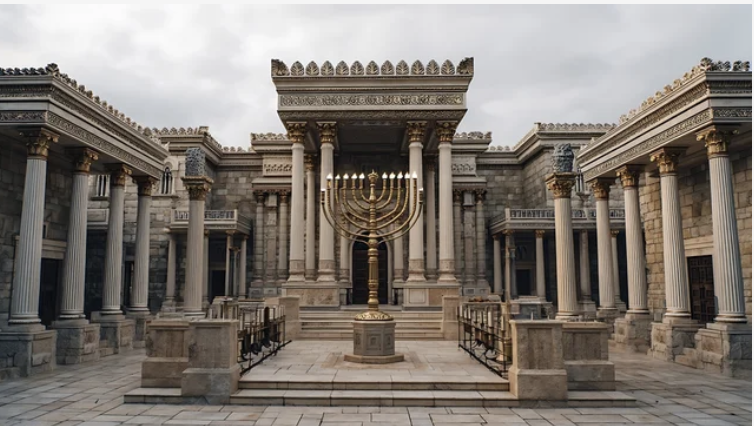
Hypothetically, it all sounds so easy just to be present with the right heart and mind. But now, would you change your mind about how easy it is if I told you that there was only one fountain in the whole world and you had to travel far? What would you do if you also had to bring a perfect lamb to sacrifice? Imagine you woke up one day and the fountain was destroyed. Where would you go to offer your penance and pennies? The Ancient Temple in Jerusalem was far greater than this “fountain” in my imaginary story.
In ancient times, people came from near and far to bring a blood sacrifice to the temple in Jerusalem and they were forgiven. They could now draw near to a Holy G-d. This is the way Adonai planned it according to Leviticus 17:11. A Jewish person in the first Century CE and our Jewish friends these days are now faced with a handful of spiritual challenging questions: Now that the temple is destroyed, how may I draw near to the Lord?
How am I to be atoned for and forgiven of iniquity? Is it just a coincidence that the temple has been destroyed and Yeshua’s followers have now proclaimed that He is the Passover lamb who was bruised for our iniquity? (Isaiah 53) In Exodus chapter twelve, the blood of the lamb on the doorposts of Jewish homes allowed G-ds wrath to pass over the Jewish people.
The scholars and rabbis had to come up with a remedy: In a world without a temple, how do we obtain forgiveness and reconciliation with Adonai. Our sages were given the task of redefining the rules or at least the path to forgiveness. The Siddur (the most central prayer book in Judaism has made this a bit unclear. On one hand, we see that by observing the 613 commandments of Torah and by observing the Talmud (Oral laws and commentaries on how to obey the Torah) passed on by the sages, we can be atoned for. On the other hand, there seem to be contradictions in the Siddur about this atonement.
There are stunning prayers where one cries out for mercy and then also mentions of not even being able to stand before a living G-d. There is even one mention of an imperfect human person making atonement for his very own life. I will give more specific illustrations below. Who are we to believe when the scriptures and the Siddur do not agree? If Mitzvot alone is the yellow brick road to G-d, then I ask, how much Mitzvot is enough? Is this yellow brick road of getting to G-d through human works alone just as imaginary as my fountain story above?
THE QUESTION OF INIQUITY
To answer the question can we get to G-d through Mitzvot alone (without a temple and without a blood atonement, let us first examine how the rabbis define iniquity. Do we even have sin in our lives if we are good people and of good standing in our communities? For those who already acknowledge the existence of a higher power and recognize iniquity, this offers an incredible opportunity to engage in a meaningful conversation about forgiveness.
Contrary to what I have understood my entire life in the secular community, our Siddurim and rabbis have never denied acknowledgement of sin and man’s inability to stand before a Holy G-d. There is even a crying out. The congregation and the chazzan recite loudly and in unison: “Hear our cry and be attentive to our declaration as on the day (referring to Adonai’s welcoming of Moses when he appeared at Mt. Sinai.” Phrases echo throughout one of many deeply heartfelt prayers called “Vidui.” There are phrases like: “Turn to us in mercy,” “You are called the Master of Mercy,” and “Turn back from your fierce anger.” (Scherman and Zlotowitz 1984, 119b). Specific iniquities are poured out in a seemingly endless list.
Our rabbis have taught us an outstanding reverence for Hashem and direct articulations of communal and personal sin are written for all to recite. “Avinu Malkeinu” is another example of a prayer (sometimes in a song) which begins: “Our Father and King, we have sinned before You” (Scherman and Zlotowitz 1984, 121). In a prayer called the “Tachanun,” the rabbis have taught us that even our chosen-ness alone will not save us: “We beg You, turn back from your anger and have mercy on the treasured nation that you have chosen” (Scherman and Zlotowitz 1984, 135).
Despite the stunning pleas, the lack of clarity about forgiveness is still unsettling. It begs the question for a Jewish man or woman, “If I should die before I wake, is my soul righteous enough and my confessions good enough for You to accept or take? (based on a nursery rhyme) “If You preserve iniquities, O G-d, my Lord, who could survive?” (Scherman and Zlotowitz 1984, 125 and Psalm 130:3-4) A beautiful confession states: “Yours, my Lord is the righteousness and ours is the shamefacedness” (Scherman and Zlotowitz 1984, 131 and Daniel 9:7, TLV).
Therefore, if we agree that man has fallen short and in desperate need of forgiveness, how do we reconcile with our all-powerful, all loving and wonderful G-d? Did confession replace what the Holy Scriptures have required of us? While confession is vital, regarding our covenant relationship with the Lord, according to the biblical mandate, I am led to believe that confession without atonement is incomplete.
As the song “Love and Marriage” song says, “we can’t have one without the other.” If the confession is the engagement ring, then the atonement is the wedding ring! From the binding of Isaac in Genesis to the hundreds of prophesies in the Holy Scriptures of a coming Messiah who would become a once and for all atonement for our iniquity, we cannot ignore this ultimate and liberating component and fulfillment of a promise!
ATONEMENT WITHOUT A TEMPLE?
Atonement, according to the Oxford dictionary, is defined as: “(in religious contexts) reparation or expiation for sin.” Some synonyms given are as such: reparation, restitution, redemption, payment, and penance. Miriam-Webster Online defines atonement as
reparation for an offense or injury: SATISFCTION.” A second more theological definition
given is “the reconciliation of God and humankind through the sacrificial death of Jesus…”
We are left to examine the question: Does the act of confession alone guarantee atonement? In a world without a temple, and without a perfect lamb to atone for our sin, should we dare believe that the observance of 613 commandments of Torah and saying the prayers in our Siddur each day has replaced or cancelled God’s original plan for atonement in the Jewish Scriptures? Like McDonalds, can we just have it our own way? Indeed, no.
Yeshua declared Himself the Messiah and made atonement for us during Passover. Is it mere coincidence that within around forty years, the second temple, where sacrifices were to be offered, was destroyed? While it might seem logical for our sages to redesign or re-interpret G-d’s plan for the benefit of the children of Israel, Deuteronomy chapter 12 does not condone this.
“Rather you are to seek only the place Adonai your God chooses from all your tribes to put His Name to dwell—there you will come. There you are to bring your burnt offerings and your sacrifices… as Adonai your God has blessed you.” (Deuteronomy 12:5-7, TLV) Leviticus 17, also describes what Adonai requires. It points out that any sacrifices offered outside the temple is considered an offering to another G-d.
“Then you are to say to them: Anyone from the house of Israel, or from the outsiders dwelling among them, who offers a burnt offering or sacrifice, but does not bring it to the entrance of the Tent of Meeting to sacrifice it to Adonai, is to be cut off from his people.” (Leviticus 17:8-9, TLV)
I imagine that throughout the Babylonian captivity, the Jewish people observed the Sabbath and holidays, substituting prayer and repentance for formal sacrifice in temple. Around the 6th Century BCE, during the Babylonian Exile, it is believed that the Jewish people began to build places of worship, prayer. (https://tinyurl.com/jd4vauj9) Perhaps it is not difficult to believe that the rabbis, who were wise scholars and sages, would find a new way to reconcile with G-d in this world after the temple was destroyed.
Synagogues were built all around the world as my Jewish people wait for the Messiah. Many have forgotten to consider that He has already come. Many feel forbidden to read the New Covenant. According to Dr. Mitch Glaser, many have not yet considered that the New Covenant is a Jewish Book written by Israeli Messianic Jewish followers of Messiah. Some people are living life with anxious desperation with unsettling thoughts of what happens after they die.
Have my people missed it? For those still seeking to find forgiveness or atonement, the promise of the Olam Habah (the world to come) is now in question and many Jewish people need to know what we are living for. Even those of us who are happy and healthy eventually find ourselves in a storm. The wealthiest among us may perceive that life is empty without a Great God who can fulfil every inner hunger.
If we walk away from a prayer service without the promise of atonement and reconciliation with God, how can we find shalom? Yeshua claimed to be the Prince of Shalom (Isaiah 9:6) . The Tachanun prayer says: “Save us with Your abundant mercy; save us from storm and anger (Scherman and Zlotowitz 1984, 131).
CLAIMS THAT ATONEMENT IS A PROMISE
In favour of the rabbis who passed down these prayers, there seems to be no confusion at all regarding atonement. While contrary to the book of Leviticus, is it possible that our humble sages felt it was their responsibility to offer an alternative without a temple? In a sacred prayer (recited daily as well as on the Sabbath, and on holidays) called “Amidah,” it is implied that atonement is promised through repentance, forgiveness, and redemption. It is evident that no blood sacrifices are mentioned in these passages.
“Bring us back, our Father…influence our return in perfect repentance” is one such phrase implying perfection and completion. “Forgive us, our Father….Who pardons abundantly.” In the Redemption portion of the “Amidah” blessing it says: “See our suffering, and redeem us speedily for your name’s sake…You are a powerful Redeemer…” Here, we see that because of who G-d is and because He exists, he will redeem or atone for us. The commentary below explains that because G–d is a loving Father; His compassion will not fail and also that if a person repents “God will make his way easier” (Scherman and Zlotowitz 1984, 99).
Redemption, however, seems to be defined as an escape from the mundane trials of daily life. Redemption in this blessing is not defined as redemption for iniquity or sin nor does it include a promise of the world to come (Scherman and Zlotowitz 1984, 103). Tension and dissonance can also be found between the promises of biblical atonement- which is shedding of blood, and possible atonement through the very character of Adonai.
The Selichot prayer (the Thirteen Attributes of Mercy” based on Exodus 34:6–7 where G-d reveals his attributes to Moses) is usually recited between Rosh Hashana and the Jewish day of atonement, Yom Kippur. This penitential prayer claims that atonement is found in G-d’s character alone. “El Rachum v’Chanun” often roughly translated as merciful and gracious. The root of the Hebrew word Rachum (Rechem), as I understand, is identical to the describing a mother’s womb, symbolizing the indescribable compassion a mother has for her child. Chanun describes God’s almost indiscriminate favour for his children.
But God is also a G-d of justice. To believe atonement requires no sacrifice is to nullify the hundreds of prophecies of Messiah in the Scriptures, promising a Passover lamb who would come to take away the iniquities and transgressions (the unintentional and intentional sins of the world). Is it safe to question the assurance of atonement for today, according to the Siddur? If the Siddur is the most trusted prayer book central to Judaism around the world and throughout the ages, how can we bring it into harmony with the biblical standard written by our most Holy G-d? Let us look at one more example.
On Yom Kippur, the day of atonement, a declaration called “Kol Nidrei” is chanted throughout synagogues everywhere. The entire day is immersed in and wrapped in words of cleansing, mercy, and in the words of Dr. Zhava Glaser, the hope of a spiritual reset. This declaration implies that upon confession, we are forgiven with no blood sacrifice.
“All vows, and things we have made forbidden on ourselves…that we have vowed, and sworn, and dedicated, and made forbidden upon ourselves; from this Yom Kippur until next Yom Kippur— …We regret having made them; may they all be permitted, forgiven, eradicated and nullified, and may they not be valid or exist any longer.” (https://tinyurl.com/4fdrvmsx) and (Scherman and Zlotowitz 1984, 763)
Lastly, on the eve of Yom Kippur, a Jewish is ritual is performed called Kapparot. As part of the ritual, a chicken (or money to be donated) is revolved around the head of a person three times while a prayer is recited three times. (Siddur, p. 773). A chilling statement is recited (changing slightly according to whether it is said for a male or female). A woman performing this for herself will say “ This is my exchange, this is my substitute, this is my atonement. This hen will go to its death (this money will go to charity) while I will enter or proceed to a good long life, and to peace.” (Scherman and Zlotowitz 1984, 775)
WHO IS THE PASSOVER LAMB?
Penning this paper one week before Passover 2025, the urgency for atonement has never been more real. In a world without a temple, it is my personal conviction that while the awesome mercy and grace of Adonai allows us to come into His presence with humility, the need for a blood atonement still stands. Isaiah 53, one of hundreds of examples, describes the suffering servant, Yeshua, the Jewish Messiah. He is the atonement we have been waiting for and we are His temple! Messiah is proposing to us and when we say yes, the promise of atonement has been forever fulfilled. We are His bride; His ultimate tabernacle and He is the Passover lamb.
In addition to my own story on National Television stations CBN and ISN, thousands have testified to encountering this lamb of G-d, finding evidence in both the Jewish Scriptures (Torah as well as the Jewish writings) and in the New Covenant. Personal stories have been poured out with the help of Chosen People Ministries and IfoundShalom.org. A Messianic movement has grown and there are hundreds of Messianic Congregations around the world. Many Jewish people have come to agree that believing in Yeshua is the completion of our faith as Jewish women and men.
While many counterfeit concepts have presented themselves, as a believer, the Jewish scriptures are G-d breathed. The Siddur offers stunning prayers based on that scripture with much poetry and wisdom from great scholars and rabbis. However, I believe in the biblical mandate for a blood sacrifice only fulfilled by my Messiah, Yeshua. Yeshua said “I am the way, the truth and the life and no one comes to the Father but through me.” (John 14:6, TLV and John 4:26, TLV) He claimed to be the Messiah. He has prepared a mansion for us and inscribed us in his book of life when we believe. The Siddur encourages us to pray: “Our father our king, inscribe us in the book of good life…in the book of redemption and salvation” (Scherman and Zlotowitz 1984, 121). Yeshua has promised:
“The one who overcomes thus will be dressed in white clothes; I will never blot his name out of the Book of Life,[a] and will confess his name before My Father and His angels.”(Revelation: 3:5)
References:
1. The Complete Artscroll Siddur, trans. Rabbi Nosson Scherman and Rabbi Meir Zlotowitz (Brooklyn: Mesorah Publications, 1984).
2. Fausnaught, Caleb. "How the Babylonian Exile Reshaped and Impacted Jesus' Judaism." Introduction to the New Testament
3. Sefaria Online Siddur, Kol Nidrei Prayer
https://www.sefaria.org/Machzor_Yom_Kippur_Ashkenaz_Linear%2C_Kol_Nidrei.16?lang=en